emBRAZEN wine’s Revolutionary Red Blend is named for Josephine Baker, who is identified on the bottle as a “showgirl.” Reading the label aloud, August, who first introduced me to Baker in our late teens, pronounced it “entertainer.”
In this, she echoed scholar Terri Simone Francis in her commitment to “treat Baker with care and seriousness as a producer of knowledge…”
+ +
Besides its Twins constellation, Gemini is associated with pretty, winged insects and birds, small things that move quickly, with a lightness of effort. Better yet is a whole group of these creatures, many small parts moving together in concert: a concentration of kingfishers, a kaleidoscope (!) of butterflies.
In her academic monograph Josephine Baker’s Cinematic Prism, Francis uses the metaphor of a prism to name the polyphony of Baker and the meanings she made, and continues to make, across fields of culture, aesthetics, movement, politics, place, and time. Her multitudinousness, “rather than breaking down Baker’s image into illegible pieces, actually constitutes a refracted image or prismatic image that can hold paradoxes, making the figure of Baker a particularly potent form of colonialist figuring and creative expression.”
This plurality is both abstract and literal, in the form of Baker’s dance. Francis notes that the polyrhythmic and polycentric movements of her style are characteristically African, referencing traditions in which “[the] seasoned performer creates a visual montage of varied and constantly changing effects with her body by dancing very quickly, emphasizing abrupt improvisational turns, jumps, bends, stretches, kicks, struts, and glides.” In addition to her independently moving hands, hips, head, and feet, “[t]he spectacle comes from Baker’s jangling jewelry, funny faces, and kinetic costumes, each contributing to the overall spectacle of motion.” (“We learn dances, brand new dances…”)
+ +
When he wasn’t living his other life on the high seas, my dad was a common visitor to my elementary school. Playing the parts of both the griot and the trickster, he’d gather my classmates around him to tell us the origin story of anything in the world we requested, stories that invariably began, in his voice, “A long, long time ago…” Then the class answering, in chorus: “… before we were born…!” Then he’d continue with the tales—the lies—he’d improvise on the spot. And here I mean “lies” in the traditional African American sense, of the telling of tall tales.
So yes, this Gemini was a liar, in more than the way you might think. And could he be insincere, another oft-cited Geminian folly? Yes. Easily distractible? Sure. As a kid I’d keep tabs on his language, letting him know, with know-it-all satisfaction, when and to what degree he’d deviated from Biblical grade truthfulness. So yes, this Gemini bent the truth—but not necessarily for the wrong reasons. At certain bedtime tuck-ins, he’d promise me only good dreams, painting a panorama of everything pleasant with his words before sending me off to sleep.
As for the trickster part, imagine eight-year-old me looking on, aghast and amazed, as he led the entire cafeteria in an impromptu rendition of “Take Me Out to the Ballgame,” every semblance of order temporarily set free.
+ +
When I think of Gemini, I think of plurality, multitudes, a scatter plot—like Sagittarius, mutability returns multitudes. But unlike Sadge so much, Gemini still craves logic. Experience, expression, adventure without sequence are kept from being data, which Gemini so loves to collect. And games are only games if they have rules. Consider Shirley Ellis’s “novelty hit,” an entire explication of the agreements and order behind the fun.
Communicative Gemini loves to teach and trades in what it knows, transmitting that knowledge through conversation in all modes and to all scales (“This is the part of me that learns from sitcoms…”). From the pinging of the group chat and the intel of neighbors to publications and the discourse around them; from the polymorphous exchanges of social media, memes of course included, to the news articles, the dictionary definitions, the podcasts, the citations, the multiple map apps on your phone (& etc.): Gemini loves it all.
“I love this!” Abram, Gemini, writer, publisher, said from across the office. “I missed this, working from home. I’m sitting over here, writing an email to this person, and you’re over there, texting that person, and we’re talking about it…!”
+ +
Though that’s not to say all that influxing info never corrodes to gossip, or manipulative rhetoric. 45 is a Gemini Sun, after all.
+ +
Like fellow Mercury-ruled Virgo, Gemini is prone to overthinking, its mind(s) moving so quickly across the vectors and variables that they can short out in nervous exhaustion (“Dig me out / Dig me in / Out of this mess, / baby, out my head”). But this also means Gemini can see more, connect more, and say, most definitely say, more.
When August (who, as a children’s librarian, holds her own kind of storytimes) and I first discussed the philosophy of truth as teenagers, she explained to me how she sees many truths, that some unitary notion of Truth made no sense to her. Sanctimonious me would have been disgusted if I hadn’t already loved her so much.
+ +
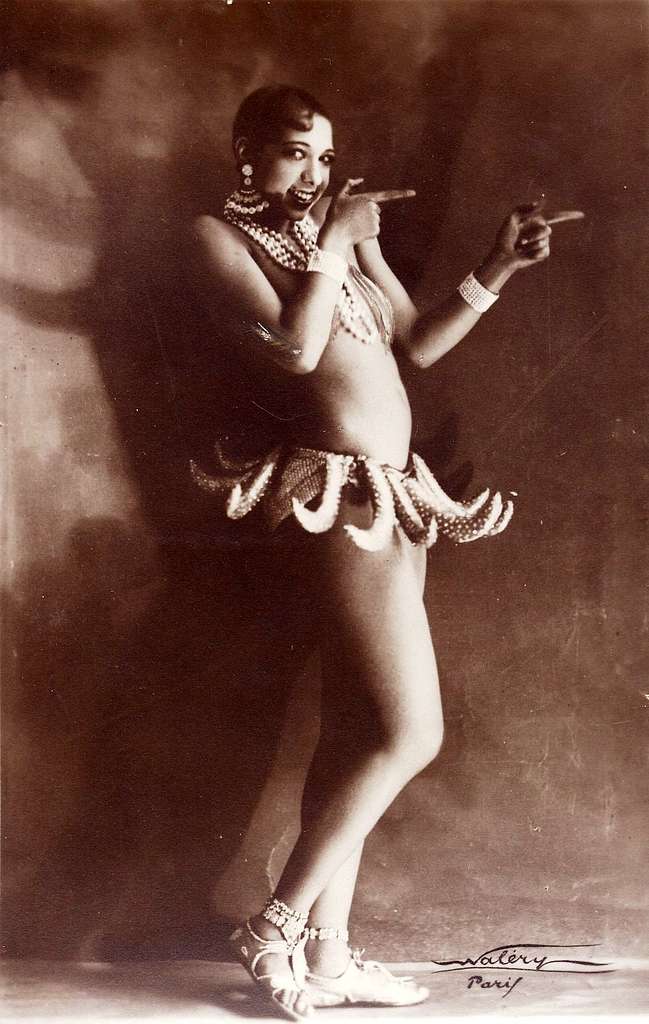
Closely aligned are the roles of the entertainer and the trickster (Tom Waits’ barker being another variation on the theme). I say that as the daughter of a Gemini professional entertainer and as a fan of numerous others. Take Baker, coquettish powerhouse of the global stage. Born under the Twins herself, Baker was famous for her transgressively playful, subversively stereotypical stage presence, from her song and dance routines to her costumes, most iconically her banana skirt ensemble.
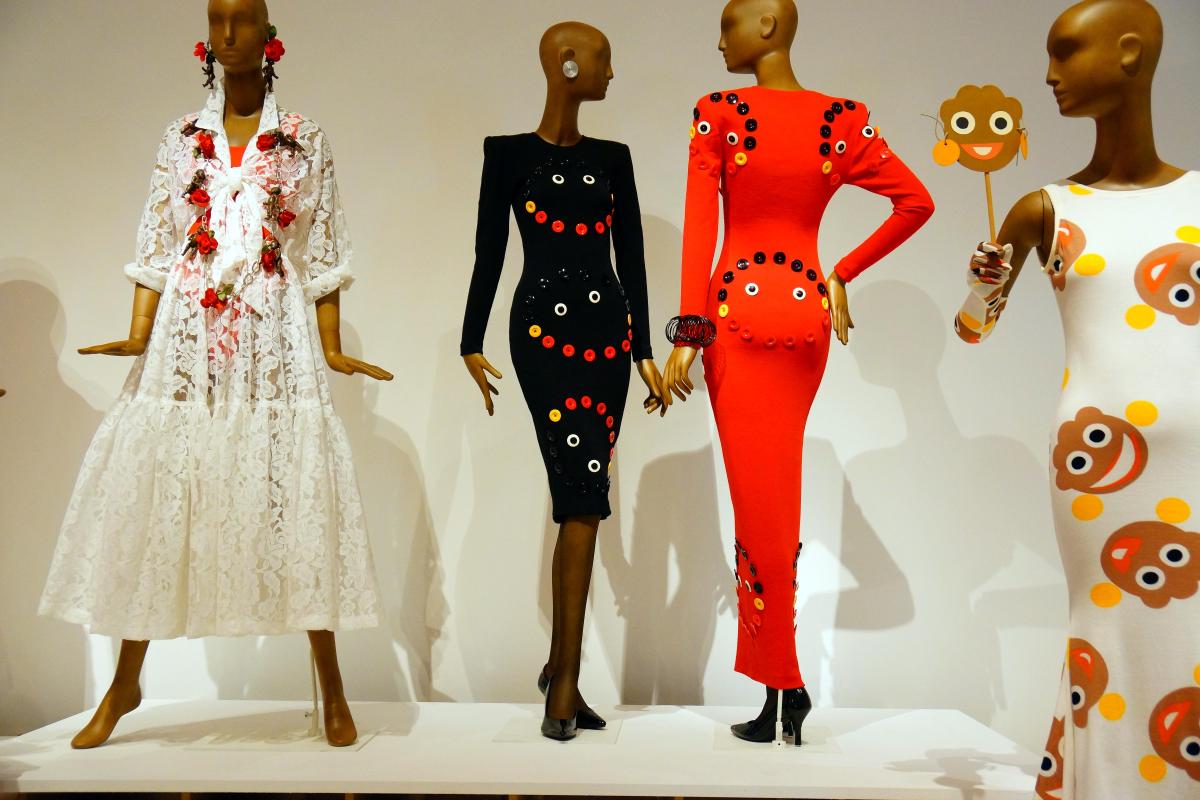
In a book on the career of fashion designer Patrick Kelly, Sequoia Barnes writes about Baker’s muse-like influence on Kelly’s work, taken to the extent of a collaboration with model Pat Cleveland, a professional model and Josephine Baker impersonator (twin, you could say).
As with Baker, there is more complexity at play beneath the cheeky surface of Cleveland’s exterior, her twinning evocation of the late Baker fleshing out deep contradictions when it comes to race, gender, desirability, performance, and power. “Humor and cuteness acted as breaks from Baker’s eroticism—barriers against complete objectification and subjection to white desire,” writes Barnes, further describing Baker’s work as camp of racial misrecognition, which “appears as if the marginalized subject is complicit in their oppression even though this appearance can be complexly layered with subversion.” For Baker, this involved the evocation of the primitivism popular at the time, as well as the subjugation and festishization of Black women like Saartje/Sarah Baartman, of Black women by Western culture at large. With the fleetness of a dancer, Baker flitted through what Toni Morrison called whiteness’s collective Africanist—antiblack, fetishizing, re-narrativizing—imagination.
Yet Black artists like Baker reappropriate that imagination, infusing its tropes with sage subjectivity and energetic reclamation. Smart and slightly frenzied fucking-with. Remixing the way we get named like Shirley Ellis, satirizing white musical royalty like Salt-N-Pepa, that indispensable duo: “Sh-sh-sh-sh-sh-sh-shake it up.”
+ +
Esu-Elegba, the two-named god of the Yoruba religion, is a trickster down to his domain: ruler of both law and order and of mischief, mercurial deity of the crossroads. “All magic began and ended with Him,” Luisah Teish writes in Jambalaya. “As messenger of the gods, He could be enticed through offerings and sacrifices to alter the course of fate by delivering a message different from the original one sent.” Esu-Elegba is indispensable to highlighting the two- or more-sidedness of any given situation, opening alternate options to a situation that may seem foreclosed. In Constructing a Nervous System, Margo Jefferson writes: “Here is Josephine Baker, virtuoso of blazing entrances and exits, shaping the world’s desires to her will. The diva as imperious sovereign and cocky rebel. The counter-diva as comedienne, hoyden {noun, dated: a boisterous girl}, flirt.”
In Josephine Baker’s Cinematic Prism, Francis quotes two other scholars who highlight Baker’s trickster energy: to Matthew Pratt Guterl, she is “a comedic critic of empire [who] stitched together the whole messy universe of colonialism into one vast backdrop.” Ramsay Burt: “What can be seen on this film are neither the Charleston itself nor an authentic African dance but a wonderfully inauthentic misleading and mischievous performance.”
It is clear why Patrick Kelly, whose work converged midcentury runway couture with the sartorial influences of his Baptist upbringing in Vicksburg, Mississippi, found in Baker a kindred spirit and muse. Exemplary of her Sun sign, Baker’s surface belies the never-ending interplay between order and mischief, between rules and play, a performer of flux, sleight, dueling revelation and disguise. Minnie Riperton might as well be singing of her:
Slipping through my fingers to dance upon the road,
The reasons for my life are more than I can hold.
But oh, the sweet delight to sing with all my might
To spark the inner light of wonder burning bright
You're not alone
You're not alone…!
+ +
August also, thank god, started signing emails “Love” before I thought it appropriate for our acquaintanceship, with the breezy affection and connectivity of her sign-kind.
“I might not come back next year, I’m thinking of moving to California,” I wrote in response to her email about National Honor Society the summer after our freshman year of high school.
“Well, I hope you stay!” she wrote back.
Reader, it meant something.
+ +
Baker led a literal double life as an undercover spy for the French resistance to the nazis, btw. When she fell ill for eighteen months in the course of this service, the Chicago Defender mistakenly reported her death. “There has been a slight error,” she stated, in correction of the record, “I’m much too busy to die.” Later, Baker was a single parent to twelve children adopted from various countries of the world, a family she audaciously nicknamed the Rainbow Tribe.
Anything less might’ve bored her. Insatiably curious and inextinguishably bright, Gemini thrives on novelty and variety—“We see people, brand new people / They’re something to see…”—silence, disconnection, stillness all sources of disconcertion. Using invisible ink on her sheet music to undetectably ferry intel among the French forces, Baker capitalized on her sign’s capacity as a messenger.
Jefferson again: “One needs many tongues to speak of Baker. One needs a hundred pairs of eyes to get ’round this woman.”
+ +
Gemini is a frequently misunderstood sign of the zodiac. Like Baker, its changeling complexities get reduced to a vague reputation of flightiness + flirtiness. Sometimes it’s out and out maligning: Geminis are untrustworthy liars, are incapable of commitment, etc. For a relatively kind example, a Lizzo lyric comes to mind: “Yeah, the old me used to love a Gemini / Like a threesome, fuckin’ with him every night / A lotta two-faced people show me both sides…”
In light of these dynamics, the words of TLC’s “FanMail”—“Just like you, I get lonely, too”—could be an appeal from Gemini to the rest of the zodiac. Or, it could be the more introverted, melancholic twin addressing its cheery social butterfly of a counterpart.
The world was shocked by Robin Williams’ tragic death, stymied by the contradiction between a career of comedy and a depression so deep living felt like a non-option. This seeming incongruity was familiar to me. While I’ll never articulately know the depths of my father’s blues, even as a kid I realized that his sunny, charming, extroverted side was just that: one side of him, the one working overtime so that the vulnerable, lonely, searching side could keep itself mostly hidden away.
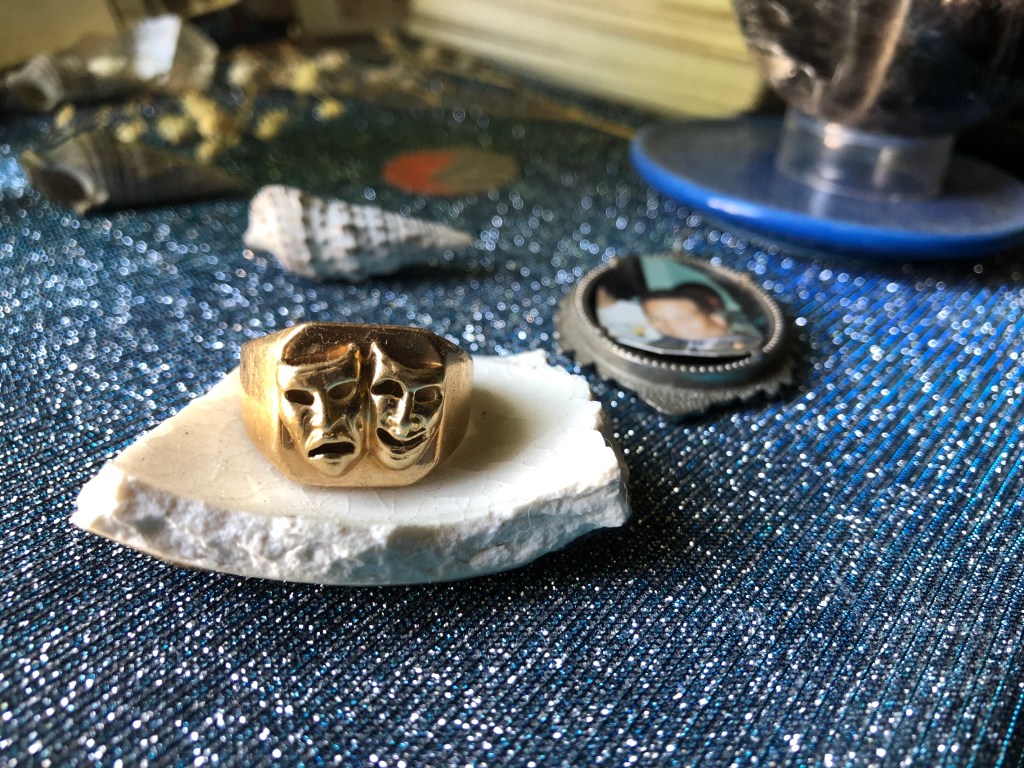
One of his many gold rings displayed the traditional Greek masks of comedy and tragedy. As a young child, I’d take his hand and study it, linking him intuitively, beyond language, with the smiling mask. But the tragic one, that scared me.
I can think of no more enduring symbol of his two-ness, a two-ness he filtered through the medium of performance: trickster Dad spinning the mood of a whole theater with one remark, the flash of wit that seemed off the cuff to them, to him a well-worn refrain; that laugh that seemed to just escape his lips as practiced as a pit orchestra’s études.
Only on recent inspection of the piece do I notice his initials, BES, engraved on the inside of the ring’s band.
+ +
Interlude! Spotted, twin flamingos in the wild! And chatty ones, at that.


(Pictured only in the negative: Twin #2, a more cramped version of #1, whose image I went back to capture only to find both twins, less than one week after the initial sighting, power-washed away [“You’ve got me…for now / I’m here… for now”]. Point one, joylessness.)
(Gemini, btw, loves the neighborhood, commuting routes, and other sorts of immediate environs, those settings at once familiar and ever-changing. These pink friends dis/appeared suddenly on one of my usual dog-walking circuits.)
+ +
1927’s La Sirène des tropiques, Baker’s first silent film, was my first time seeing her effervescence in motion. Like with Gemini itself, her fullest beauty comes in movement—photos are one thing, but Baker was a dancer. On film she is captivating, giving me butterflies bearing tears. In a film where gesture and expression carry plot and character development entirely, even her actionless shots are imbued with a body of feeling. Protagonist Papitou, with her knowing ebullience, is Baker’s twin, her autobiographical projection. She is like the inverse of Toi Derricote’s lines: “I keep trying to prove / I am not what I think you think.” Maybe: “I keep proving what I am / and you keep trying to think.”
The star, indeed, and the sun of the film, Baker plays fearlessly with race. After swimming out to meet the ship carrying the light of her life, a white French man named André, away from her natal “tropiques,” Papitou hides in the coal chute, the dust blackening her skin in a way reminiscent of minstrel makeup. She makes her way stealthily down the hall, wielding a fetish.


She soon crosses paths with a wealthy white woman passenger, who immediately calls the (ship) police.

As the search party aggregates, Papitou climbs into the galley’s ash bin to hide, at which point she’s re-coated white and ends up scaring the same lady again.



Finding an unlocked stateroom, she takes herself to the bath, washing the residue of race away and re-revealing her natural skin.


When the mob finally catches up to her, her sternness at being intruded upon while bathing—the respectable reaction of a proper lady—flips to un-self-conscious, easy pleasure.


The character of Papitou is implicitly mixed-race, an alcoholic white father her only pictured parent. When Papitou, just sexually assaulted by their landlord, makes it home to said parent, her father’s response to his daughter’s plight at the hands of another white man is, er, passive at best.

The gaze Papitou sends in response—of bone-deep exhaustion, disappointment, and hurt that her father doesn’t see her as worthy of protection—not like he imaginably would a white daughter—carries a resonance underscored by her character’s overall buoyancy. For her capering whimsy, her weary sorrow is all the more arresting.



The friction between her jovial mask and her unveiled fragility serves gutting pathos. What’s more, her stereotyped stylings are destabilized, turned to buzzing questions. Suddenly the “simple native” is tremulously complicated, reconfiguring both her own character and the white gaze she beckons just to hoodwink. She submits for discussion the complexity of her joy.
+ +
In his phenomenal memoir Heavy, Kiese Laymon uses the unhyphenated, conjoined “happysad” to capture the dualities of living and relating in and through trauma as Black Southern poor people under capitalist heteropatriarchy: “Telling happysad stories about what just happened was really all the big boys at Beulah Beauford’s house did well. Whether they were true or not didn’t matter.”
The coinage comes to mind in a simpler sense when I listen to 2003’s “Hey Ya!” Laymon has written about OutKast in multiple works, particularly their groundbreaking album Aquemini, a portmanteau of “Aquarius” and “Gemini,” the respective Sun signs of Big Boi and André 3000 (and also me and my dad’s Sun signs, and also me and August’s Sun signs). In an essay, Laymon contrasts the duo’s respective poses on the cover of their album ATLiens: “Big Boi’s fingers were clinched, ready to fight. André’s were spread, ready to conjure.”
“Hey Ya!” is one of the few top 40 songs I remember my dad unironically liking (and I mean, it is excellent) (eleven-year-old me, meanwhile: “wtf[rick] is ‘cum-a’??”). In a sublimely pop-crossover way, the song captures the existential bittersweetness of living and loving, from the mouth of a knowing yet not properly heeded hypeman-narrator-emcee—the elucidator on the stage. I wonder if Dad ever heard himself in André’s “Y’all don’t wanna hear me, you just wanna dance.…”
+ +
August and my dad, Blair, are actually birthday twins, twins of the Twins, if you will. Astrologically, a shared birthdate alone doesn’t mean the most, but that fact has always meant a lot to me. They never met; the way fortune was spun, they couldn’t have. I wonder what they would’ve talked about.
Suggested activity pairings:
- Catching up on your tabs and/or texts!
- Chatting (or deeper) with neighbors, siblings, coworkers, and others who enliven your social horizons!
- Taking swallow-like sips of topics that intrigue you, perhaps by flipping through some impulsive library/bookstore picks or getting lost in Wikipedia! Bonus points for new words learned!
- Doing a puzzle or playing a game! Bonus points if words are involved!
- Taking a walk around your block and seeing what you can spot that’s new!
Happy Gemini season! May your curiosity hold both the happy and the sad with friendliness and your wonder brighten what you know / you don’t know
(yet).
more soon 🌙 !


 Chelsey K. Shannon
