Photo by Cayobo, https://www.flickr.com/photos/cayobo/2864302840
“I hate myself right now!” Not words anyone relishes saying, but words I imagine everyone has felt at some point. Even if, when you’re saying them, you feel uniquely tragic, impossible to reach.
I said this about myself in the car earlier this week, in a fit of pique and insecurity and dread. August and I were setting out for a mutually long day. Later on, I was going to speak publicly about a self-published project of mine, a zine in which I write on, among other things, loss, power, violence, place, time, and identity, including those aspects of my own that lend me shame, confusion, contradiction. To write this was one thing. To stand by these words and attempt to sum them up in front of people was another. In past attempts to distribute the zine, I’d felt the same angst fermenting to self-directed antipathy. Any confidence was being swallowed by ambivalence—about myself, my project, my belonging, the latter being one of the hearts of the zine itself. Still, why couldn’t I just be excited? Why couldn’t I be happy to have this zine, little book, really, in my hands? Why couldn’t I let my enthusiasm spark likewise in others? Why do I have to overthink and -feel everything?
“Why is it whenever I try to do something with this project, I have some kind of episode!” I yell-cry-cry-cried to August, whose gentle touch on my shoulder prompted my raw admission which, in turn, broke my surliness into tears (“the water’s runnin’ free…”). I was craving some resource, some strength—from within or without myself, it wasn’t clear.
“Maybe today you can just embrace the ambivalence, and let the rest of it go,” she said.
Letting go seemed impossible, yet what I hated was how impossible I was feeling. Poisonous pen posed, dying of need inside. But still, there was a bigger transformation I was resisting: to let die my armed “dreams” of perfection, my dueling fears of and cravings for soul-exposure like illuminated scorpions skittering to the dark. I met my first ever in scorpion Arizona this summer on a trip with my friends, in the bathroom of our VRBO. It was smaller than I expected. Plucky, but softer looking, more crushable. I let it drink my shower water off the tiles in the dark.
Scorpio has a reputation of ferocity, and that is not misplaced. But scorpions love the darkness because it protects them, and water because it’s what sustains.
Were my ill-timed tears also about survival? Could relinquishing truly be the way?
This season, because of where and how Scorpio resides in my natal chart, I’d expected a creative harvest. I expected strides on my memoir project, shattering emotional insights. I expected renewed fortitude to drill down into the old story of my mother, Amy, my primordial Scorpio, a major subject of my memoir and emblem of my wounds.
These are now the final hours of this year’s Scorpio season. Turned out, I didn’t want to do that. What I wanted was to rest. What I wanted was a dark, warm, quiet room. What I wanted was to bathe. I stewarded necessarily, unclogged my shower drain of shedded hair and honeycomb wax. We had the kitchen sink looked at by twin brother plumbers born under the sign of Scorpio, and one of them tattoo-proud of that.
Then there’s the newer stewardship of getting myself to the gym—an Amyan activity, to be sure. I shadow her ghost while lying there on the bench of the reverse leg curl machine, feeling slightly sickened by those last four reps, but then: the triumph of fatigue. When I stand, I feel sturdier than I’ve felt in years.
The movements I choose are measures of self-healing. My knee that’s ached with every step of the last decade is slowly gaining the support it needs, and my right foot slowly relaxes, re-levels itself in turn. My slackened hamstrings remember their edges. Then there’s stretching later, when the fatigue of the workout gets reconfigured as a delicious pleasure.
At the panel I attend before the one I’m on, Marian Moore reads her poem about her mother, “My Mother in the Mirror”:
There you are again, reflected before me in the gym mirrors.
And I have just enough Zen and physics, Biology and Shinto, To not greet your image with amazement.
What is time anyway?
My answer: time is a probe, an oracle. It is a morass of feeling, recollection, and instinct. It is grief. Anger like caves. “Slippery beginnings.” Transformation, the nymph shuttering off its first skin. Sullen hurt, grizzled rue. Desires, raucous. Boundaries, staunch. Sacrifices, willing and otherwise. Revenge fever dreams. The sublime mystery of the turn. Thirst like there’s nothing but this night is what you’ll find contained below. And, in some cellar of you.
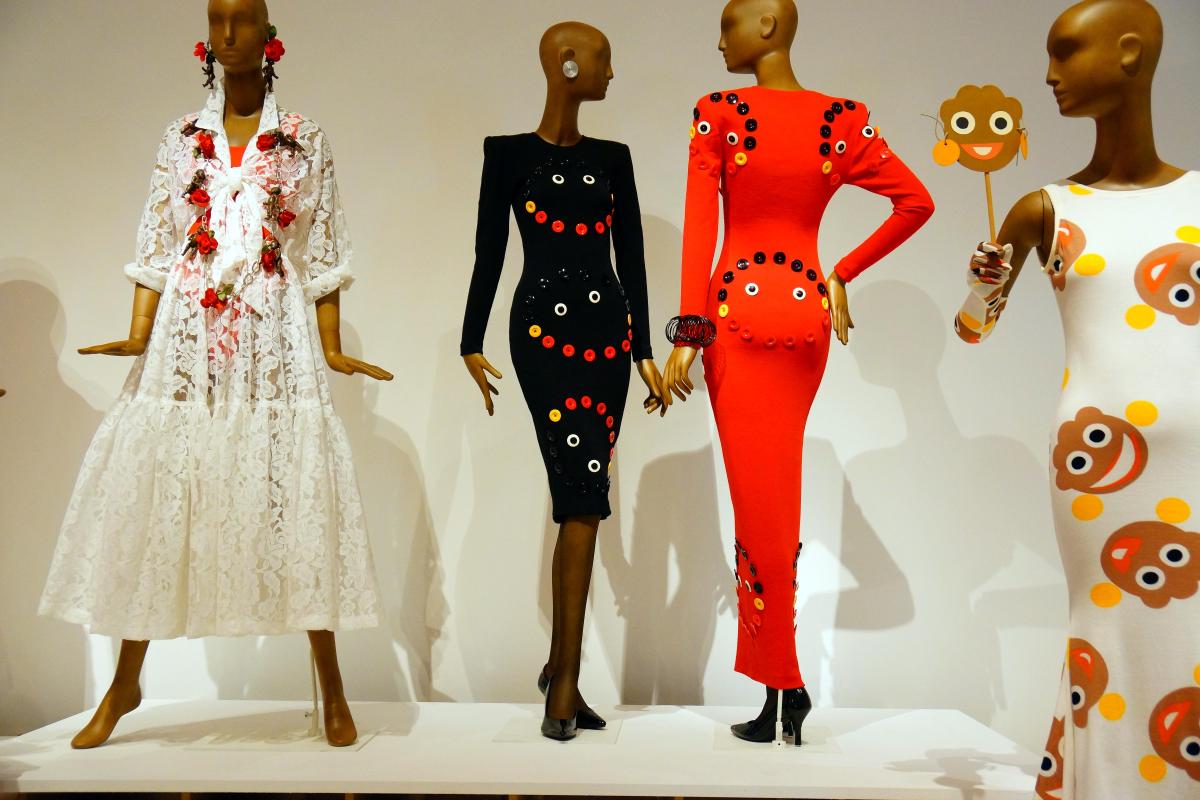
Patrick Kelly's Runway of Love exhibition at the Philadelphia Museum of Art, 2014.
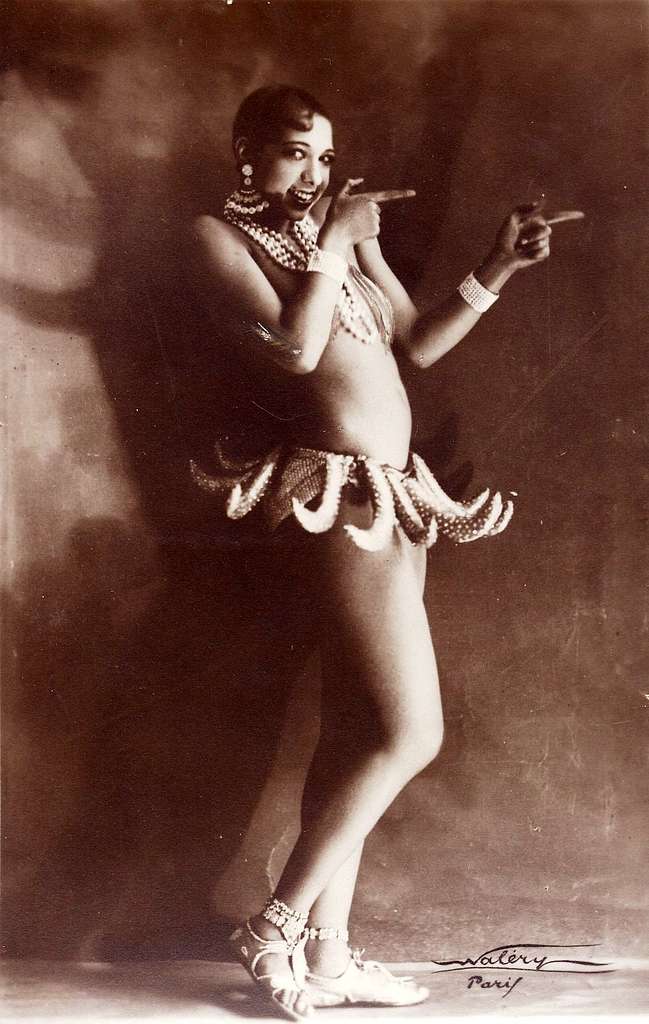
emBRAZEN wine’s Revolutionary Red Blend is named for Josephine Baker, who is identified on the bottle as a “showgirl.” Reading the label aloud, August, who first introduced me to Baker in our late teens, pronounced it “entertainer.”
In this, she echoed scholar Terri Simone Francis in her commitment to “treat Baker with care and seriousness as a producer of knowledge…”
+ +
Besides its Twins constellation, Gemini is associated with pretty, winged insects and birds, small things that move quickly, with a lightness of effort. Better yet is a whole group of these creatures, many small parts moving together in concert: a concentration of kingfishers, a kaleidoscope (!) of butterflies.
In her academic monograph Josephine Baker’s Cinematic Prism, Francis uses the metaphor of a prism to name the polyphony of Baker and the meanings she made, and continues to make, across fields of culture, aesthetics, movement, politics, place, and time. Her multitudinousness, “rather than breaking down Baker’s image into illegible pieces, actually constitutes a refracted image or prismatic image that can hold paradoxes, making the figure of Baker a particularly potent form of colonialist figuring and creative expression.”
This plurality is both abstract and literal, in the form of Baker’s dance. Francis notes that the polyrhythmic and polycentric movements of her style are characteristically African, referencing traditions in which “[the] seasoned performer creates a visual montage of varied and constantly changing effects with her body by dancing very quickly, emphasizing abrupt improvisational turns, jumps, bends, stretches, kicks, struts, and glides.” In addition to her independently moving hands, hips, head, and feet, “[t]he spectacle comes from Baker’s jangling jewelry, funny faces, and kinetic costumes, each contributing to the overall spectacle of motion.” (“We learn dances, brand new dances…”)
+ +
When he wasn’t living his other life on the high seas, my dad was a common visitor to my elementary school. Playing the parts of both the griot and the trickster, he’d gather my classmates around him to tell us the origin story of anything in the world we requested, stories that invariably began, in his voice, “A long, long time ago…” Then the class answering, in chorus: “… before we were born…!” Then he’d continue with the tales—the lies—he’d improvise on the spot. And here I mean “lies” in the traditional African American sense, of the telling of tall tales.
So yes, this Gemini was a liar, in more than the way you might think. And could he be insincere, another oft-cited Geminian folly? Yes. Easily distractible? Sure. As a kid I’d keep tabs on his language, letting him know, with know-it-all satisfaction, when and to what degree he’d deviated from Biblical grade truthfulness. So yes, this Gemini bent the truth—but not necessarily for the wrong reasons. At certain bedtime tuck-ins, he’d promise me only good dreams, painting a panorama of everything pleasant with his words before sending me off to sleep.
As for the trickster part, imagine eight-year-old me looking on, aghast and amazed, as he led the entire cafeteria in an impromptu rendition of “Take Me Out to the Ballgame,” every semblance of order temporarily set free.
+ +
When I think of Gemini, I think of plurality, multitudes, a scatter plot—like Sagittarius, mutability returns multitudes. But unlike Sadge so much, Gemini still craves logic. Experience, expression, adventure without sequence are kept from being data, which Gemini so loves to collect. And games are only games if they have rules. Consider Shirley Ellis’s “novelty hit,” an entire explication of the agreements and order behind the fun.
Communicative Gemini loves to teach and trades in what it knows, transmitting that knowledge through conversation in all modes and to all scales (“This is the part of me that learns from sitcoms…”). From the pinging of the group chat and the intel of neighbors to publications and the discourse around them; from the polymorphous exchanges of social media, memes of course included, to the news articles, the dictionary definitions, the podcasts, the citations, the multiple map apps on your phone (& etc.): Gemini loves it all.
“I love this!” Abram, Gemini, writer, publisher, said from across the office. “I missed this, working from home. I’m sitting over here, writing an email to this person, and you’re over there, texting that person, and we’re talking about it…!”
+ +
Though that’s not to say all that influxing info never corrodes to gossip, or manipulative rhetoric. 45 is a Gemini Sun, after all.
+ +
Like fellow Mercury-ruled Virgo, Gemini is prone to overthinking, its mind(s) moving so quickly across the vectors and variables that they can short out in nervous exhaustion (“Dig me out / Dig me in / Out of this mess, / baby, out my head”). But this also means Gemini can see more, connect more, and say, most definitely say, more.
When August (who, as a children’s librarian, holds her own kind of storytimes) and I first discussed the philosophy of truth as teenagers, she explained to me how she sees many truths, that some unitary notion of Truth made no sense to her. Sanctimonious me would have been disgusted if I hadn’t already loved her so much.
+ +
Closely aligned are the roles of the entertainer and the trickster (Tom Waits’ barker being another variation on the theme). I say that as the daughter of a Gemini professional entertainer and as a fan of numerous others. Take Baker, coquettish powerhouse of the global stage. Born under the Twins herself, Baker was famous for her transgressively playful, subversively stereotypical stage presence, from her song and dance routines to her costumes, most iconically her banana skirt ensemble.
In a book on the career of fashion designer Patrick Kelly, Sequoia Barnes writes about Baker’s muse-like influence on Kelly’s work, taken to the extent of a collaboration with model Pat Cleveland, a professional model and Josephine Baker impersonator (twin, you could say).
As with Baker, there is more complexity at play beneath the cheeky surface of Cleveland’s exterior, her twinning evocation of the late Baker fleshing out deep contradictions when it comes to race, gender, desirability, performance, and power. “Humor and cuteness acted as breaks from Baker’s eroticism—barriers against complete objectification and subjection to white desire,” writes Barnes, further describing Baker’s work as camp of racial misrecognition, which “appears as if the marginalized subject is complicit in their oppression even though this appearance can be complexly layered with subversion.” For Baker, this involved the evocation of the primitivism popular at the time, as well as the subjugation and festishization of Black women like Saartje/Sarah Baartman, of Black women by Western culture at large. With the fleetness of a dancer, Baker flitted through what Toni Morrison called whiteness’s collective Africanist—antiblack, fetishizing, re-narrativizing—imagination.
Yet Black artists like Baker reappropriate that imagination, infusing its tropes with sage subjectivity and energetic reclamation. Smart and slightly frenzied fucking-with. Remixing the way we get named like Shirley Ellis, satirizing white musical royalty like Salt-N-Pepa, that indispensable duo: “Sh-sh-sh-sh-sh-sh-shake it up.”
+ +
Esu-Elegba, the two-named god of the Yoruba religion, is a trickster down to his domain: ruler of both law and order and of mischief, mercurial deity of the crossroads. “All magic began and ended with Him,” Luisah Teish writes in Jambalaya. “As messenger of the gods, He could be enticed through offerings and sacrifices to alter the course of fate by delivering a message different from the original one sent.” Esu-Elegba is indispensable to highlighting the two- or more-sidedness of any given situation, opening alternate options to a situation that may seem foreclosed. In Constructing a Nervous System, Margo Jefferson writes: “Here is Josephine Baker, virtuoso of blazing entrances and exits, shaping the world’s desires to her will. The diva as imperious sovereign and cocky rebel. The counter-diva as comedienne, hoyden {noun, dated: a boisterous girl}, flirt.”
In Josephine Baker’s Cinematic Prism, Francis quotes two other scholars who highlight Baker’s trickster energy: to Matthew Pratt Guterl, she is “a comedic critic of empire [who] stitched together the whole messy universe of colonialism into one vast backdrop.” Ramsay Burt: “What can be seen on this film are neither the Charleston itself nor an authentic African dance but a wonderfully inauthentic misleading and mischievous performance.”
It is clear why Patrick Kelly, whose work converged midcentury runway couture with the sartorial influences of his Baptist upbringing in Vicksburg, Mississippi, found in Baker a kindred spirit and muse. Exemplary of her Sun sign, Baker’s surface belies the never-ending interplay between order and mischief, between rules and play, a performer of flux, sleight, dueling revelation and disguise. Minnie Riperton might as well be singing of her:
Slipping through my fingers to dance upon the road,The reasons for my life are more than I can hold.But oh, the sweet delight to sing with all my mightTo spark the inner light of wonder burning brightYou're not aloneYou're not alone…!
+ +
August also, thank god, started signing emails “Love” before I thought it appropriate for our acquaintanceship, with the breezy affection and connectivity of her sign-kind.
“I might not come back next year, I’m thinking of moving to California,” I wrote in response to her email about National Honor Society the summer after our freshman year of high school.
“Well, I hope you stay!” she wrote back.
Reader, it meant something.
+ +
Baker led a literal double life as an undercover spy for the French resistance to the nazis, btw. When she fell ill for eighteen months in the course of this service, the Chicago Defender mistakenly reported her death. “There has been a slight error,” she stated, in correction of the record, “I’m much too busy to die.” Later, Baker was a single parent to twelve children adopted from various countries of the world, a family she audaciously nicknamed the Rainbow Tribe.
Anything less might’ve bored her. Insatiably curious and inextinguishably bright, Gemini thrives on novelty and variety—“We see people, brand new people / They’re something to see…”—silence, disconnection, stillness all sources of disconcertion. Using invisible ink on her sheet music to undetectably ferry intel among the French forces, Baker capitalized on her sign’s capacity as a messenger.
Jefferson again: “One needs many tongues to speak of Baker. One needs a hundred pairs of eyes to get ’round this woman.”
+ +
Gemini is a frequently misunderstood sign of the zodiac. Like Baker, its changeling complexities get reduced to a vague reputation of flightiness + flirtiness. Sometimes it’s out and out maligning: Geminis are untrustworthy liars, are incapable of commitment, etc. For a relatively kind example, a Lizzo lyric comes to mind: “Yeah, the old me used to love a Gemini / Like a threesome, fuckin’ with him every night / A lotta two-faced people show me both sides…”
In light of these dynamics, the words of TLC’s “FanMail”—“Just like you, I get lonely, too”—could be an appeal from Gemini to the rest of the zodiac. Or, it could be the more introverted, melancholic twin addressing its cheery social butterfly of a counterpart.
The world was shocked by Robin Williams’ tragic death, stymied by the contradiction between a career of comedy and a depression so deep living felt like a non-option. This seeming incongruity was familiar to me. While I’ll never articulately know the depths of my father’s blues, even as a kid I realized that his sunny, charming, extroverted side was just that: one side of him, the one working overtime so that the vulnerable, lonely, searching side could keep itself mostly hidden away.
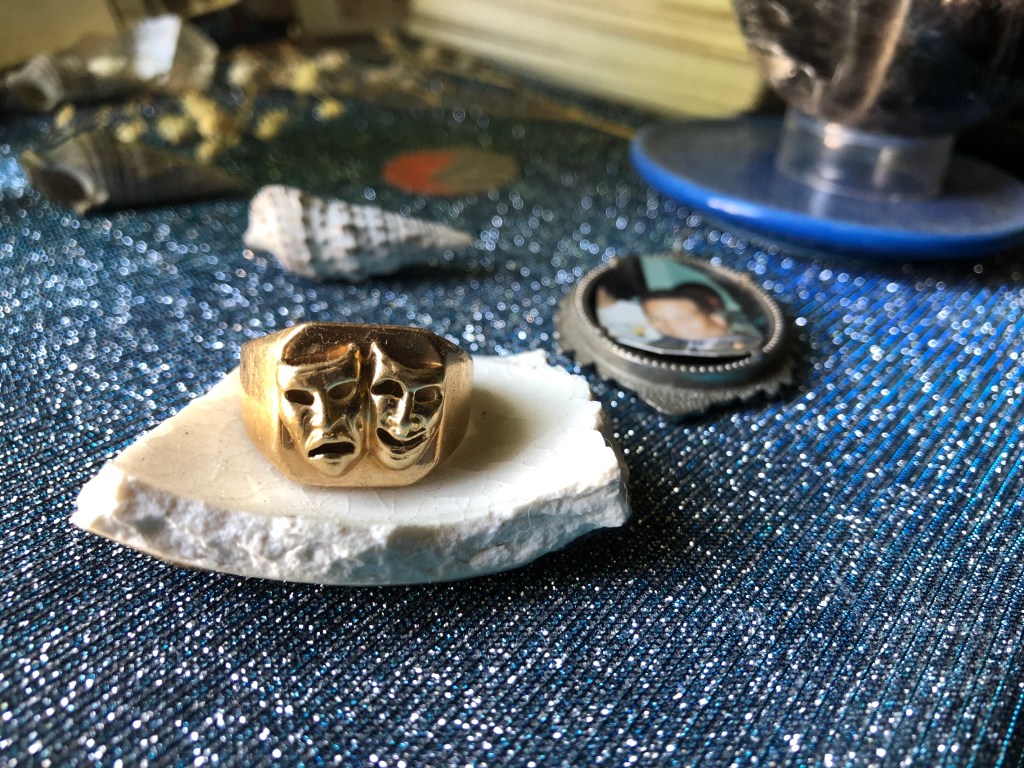
One of his many gold rings displayed the traditional Greek masks of comedy and tragedy. As a young child, I’d take his hand and study it, linking him intuitively, beyond language, with the smiling mask. But the tragic one, that scared me.
I can think of no more enduring symbol of his two-ness, a two-ness he filtered through the medium of performance: trickster Dad spinning the mood of a whole theater with one remark, the flash of wit that seemed off the cuff to them, to him a well-worn refrain; that laugh that seemed to just escape his lips as practiced as a pit orchestra’s études.
Only on recent inspection of the piece do I notice his initials, BES, engraved on the inside of the ring’s band.
+ +
Interlude! Spotted, twin flamingos in the wild! And chatty ones, at that.
(Pictured only in the negative: Twin #2, a more cramped version of #1, whose image I went back to capture only to find both twins, less than one week after the initial sighting, power-washed away [“You’ve got me…for now / I’m here… for now”]. Point one, joylessness.)
(Gemini, btw, loves the neighborhood, commuting routes, and other sorts of immediate environs, those settings at once familiar and ever-changing. These pink friends dis/appeared suddenly on one of my usual dog-walking circuits.)
+ +
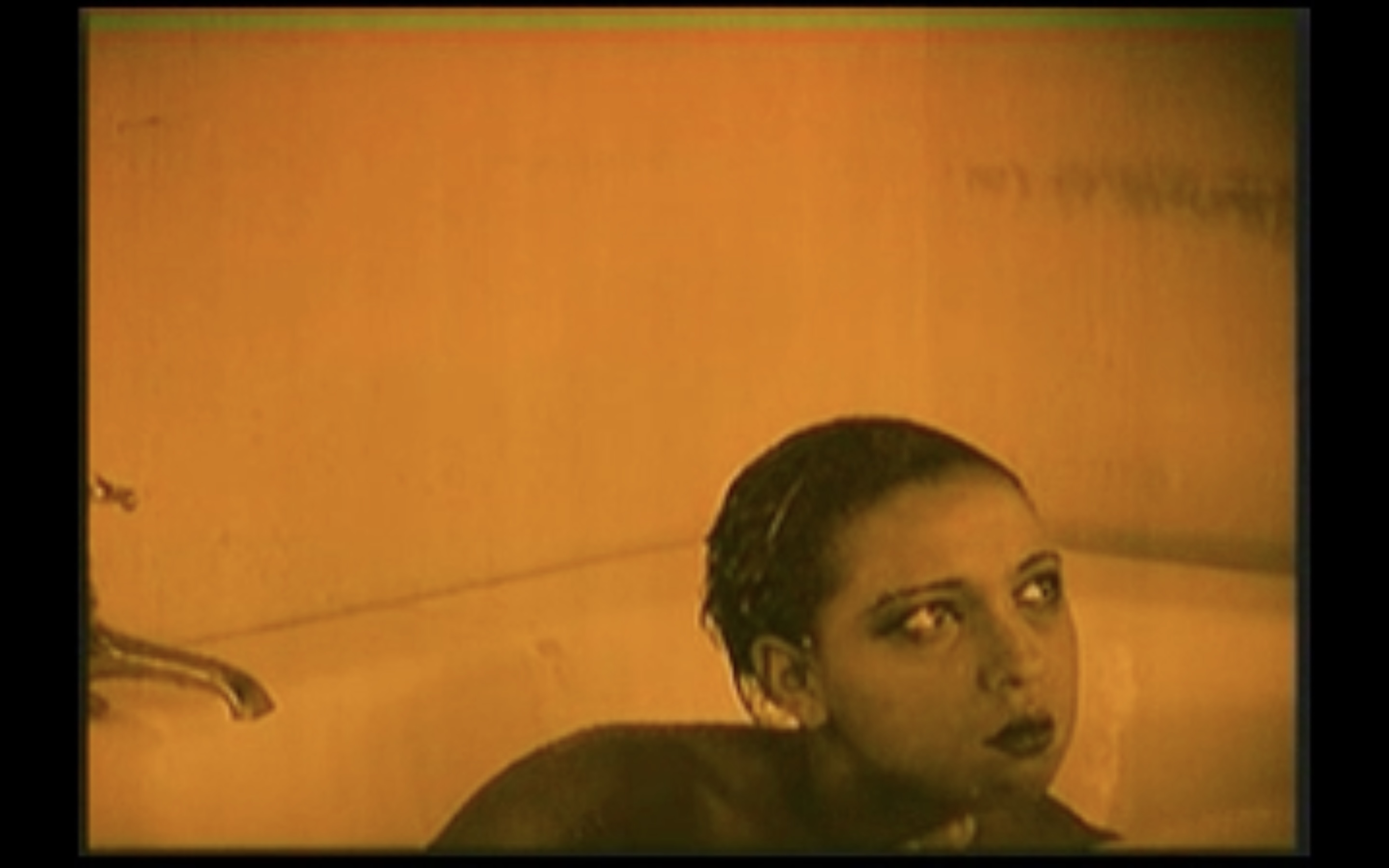
1927’s La Sirène des tropiques, Baker’s first silent film, was my first time seeing her effervescence in motion. Like with Gemini itself, her fullest beauty comes in movement—photos are one thing, but Baker was a dancer. On film she is captivating, giving me butterflies bearing tears. In a film where gesture and expression carry plot and character development entirely, even her actionless shots are imbued with a body of feeling. Protagonist Papitou, with her knowing ebullience, is Baker’s twin, her autobiographical projection. She is like the inverse of Toi Derricote’s lines: “I keep trying to prove / I am not what I think you think.” Maybe: “I keep proving what I am / and you keep trying to think.”
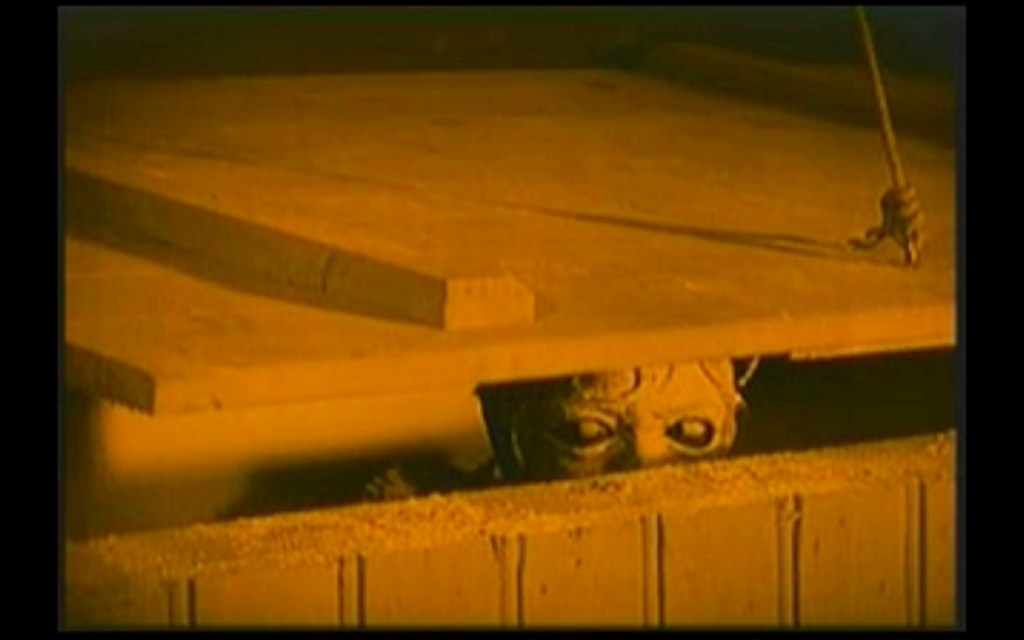
The star, indeed, and the sun of the film, Baker plays fearlessly with race. After swimming out to meet the ship carrying the light of her life, a white French man named André, away from her natal “tropiques,” Papitou hides in the coal chute, the dust blackening her skin in a way reminiscent of minstrel makeup. She makes her way stealthily down the hall, wielding a fetish.
She soon crosses paths with a wealthy white woman passenger, who immediately calls the (ship) police.
As the search party aggregates, Papitou climbs into the galley’s ash bin to hide, at which point she’s re-coated white and ends up scaring the same lady again.
Finding an unlocked stateroom, she takes herself to the bath, washing the residue of race away and re-revealing her natural skin.
When the mob finally catches up to her, her sternness at being intruded upon while bathing—the respectable reaction of a proper lady—flips to un-self-conscious, easy pleasure.
Pull on the slider.
The character of Papitou is implicitly mixed-race, an alcoholic white father her only pictured parent. When Papitou, just sexually assaulted by their landlord, makes it home to said parent, her father’s response to his daughter’s plight at the hands of another white man is, er, passive at best.
The gaze Papitou sends in response—of bone-deep exhaustion, disappointment, and hurt that her father doesn’t see her as worthy of protection—not like he imaginably would a white daughter—carries a resonance underscored by her character’s overall buoyancy. For her capering whimsy, her weary sorrow is all the more arresting.
The friction between her jovial mask and her unveiled fragility serves gutting pathos. What’s more, her stereotyped stylings are destabilized, turned to buzzing questions. Suddenly the “simple native” is tremulously complicated, reconfiguring both her own character and the white gaze she beckons just to hoodwink. She submits for discussion the complexity of her joy.
+ +
In his phenomenal memoir Heavy, Kiese Laymon uses the unhyphenated, conjoined “happysad” to capture the dualities of living and relating in and through trauma as Black Southern poor people under capitalist heteropatriarchy: “Telling happysad stories about what just happened was really all the big boys at Beulah Beauford’s house did well. Whether they were true or not didn’t matter.”
The coinage comes to mind in a simpler sense when I listen to 2003’s “Hey Ya!” Laymon has written about OutKast in multiple works, particularly their groundbreaking album Aquemini, a portmanteau of “Aquarius” and “Gemini,” the respective Sun signs of Big Boi and André 3000 (and also me and my dad’s Sun signs, and also me and August’s Sun signs). In an essay, Laymon contrasts the duo’s respective poses on the cover of their album ATLiens: “Big Boi’s fingers were clinched, ready to fight. André’s were spread, ready to conjure.”
“Hey Ya!” is one of the few top 40 songs I remember my dad unironically liking (and I mean, it is excellent) (eleven-year-old me, meanwhile: “wtf[rick] is ‘cum-a’??”). In a sublimely pop-crossover way, the song captures the existential bittersweetness of living and loving, from the mouth of a knowing yet not properly heeded hypeman-narrator-emcee—the elucidator on the stage. I wonder if Dad ever heard himself in André’s “Y’all don’t wanna hear me, you just wanna dance.…”
+ +
August and my dad, Blair, are actually birthday twins, twins of the Twins, if you will. Astrologically, a shared birthdate alone doesn’t mean the most, but that fact has always meant a lot to me. They never met; the way fortune was spun, they couldn’t have. I wonder what they would’ve talked about.
Remember, shuffle off!
Suggested activity pairings:
Catching up on your tabs and/or texts!
Chatting (or deeper) with neighbors, siblings, coworkers, and others who enliven your social horizons!
Taking swallow-like sips of topics that intrigue you, perhaps by flipping through some impulsive library/bookstore picks or getting lost in Wikipedia! Bonus points for new words learned!
Doing a puzzle or playing a game! Bonus points if words are involved!
Taking a walk around your block and seeing what you can spot that’s new!
Happy Gemini season! May your curiosity hold both the happy and the sad with friendliness and your wonder brighten what you know / you don’t know (yet).
Bull Thistle (Cirsium arizonica) (1938) by Mary Vaux Walcott. Original from The Smithsonian. Digitally enhanced by rawpixel.
When I was a kid, one of my favorite videos was Ferdinand the Bull. Growing up in pastoral Spain alongside feistier bullocks, who dream of one day facing matadors in the ring, Ferdinand just wants to chill and smell the flowers.
“Sit…in the quiet…and smell the flowers.”
This, despite growing to be the biggest, strongest bull of his cohort. When the time comes for the bullfighters to come looking for the fiercest match, Ferdinand is happy to keep to his solitary, flower-flocked tree instead of showing off. But then, a twist: just as he settles in for a good smelling session, a bee stings Ferdinand’s behind, sparking a tantrum of pain the scouts mistake for ferocity.
So, Ferdinand is hauled off to Madrid. Unpersuaded, he declines to enter the ring—until a fan in the stands tosses the impatient matador a bouquet. That gets the bull’s attention, though still not in the way the matador wants. For, just like on his home hillside, Ferdinand buries his snout in the flowers, paying the bullfighter’s incitations no mind. Denied his due battle, the once-martial matador is reduced to tears of desperation. But exposing his chest in beseechment—along with it a flower tattoo for a sweetheart named Daisy—earns him only a big, juicy (and literal) cow lick from his would-be foe.
To me it seems no coincidence that we have a bull here repping the value of slowness, peace and quiet, shameless indulgence in nature’s beauty—and equally shameless indulgence in one’s own prerogative. A charming if thirties-weird study of pacifistic stubbornness, Ferdinand gets his way not just through refusal, but through staunch commitment to his own pleasure. When the short closes, he’s right back on his hillside and, the narrator assures, “very happy.” (“Took my heart to the limit, and this is where I stay.”)
(Is it embarrassing to like a song by the Black Eyed Peas? I feel like it is.)
Sensory, tactile, and abundant, Taurus—i.e. the Bull, if you didn’t catch that—is more embodied and pleasure-loving than my Midwestern Catholic upbringing shaped me to embrace. Images of abundance were articulated, and swiftly undercut, most archetypally by the Garden of Eden, that paradise flirted with and swiftly lost to a destiny of arid toil.
The illustrations in my children’s Bible put the contrast quite vividly. As if to freeze the Old Testament’s progression into brutality and punishment, I’d take the book from my dad’s hands and linger on the beautiful: the lush plants, the newly named animals…and the ubiquitous fig leaves covering Adam and Eve’s goods.
“What’s that?” I asked once. “Be fruitful?” I knew what fruit was, of course. But how would that apply to people, as a directive?
“Have babies,” he answered gruffly. “Procreate and populate the world.” He moved the conversation along before I could press on the meaning behind that word, fruitful.
It’d be a mistake to brand Taurus as the sexual sign. To name a few others: Libra, like Taurus, is ruled by Venus, the planet of love, romance and attraction, among other things; within the verve of Aries lives a robust libido; Scorpio rules the genitals and especially hidden or taboo sexuality; and Cancer and Leo are both associated with lineage. What makes Taurus’ relationship to this domain of life special is its emphasis on fecundity—whether as the fruitfulness Old Testament God was demanding, or the flowering of pleasure at large. It’s pleasure that may or may not be strictly sexual but is always grounded in the Earth and the physical. There can even be a sense of friendliness with the corporeal (“Other times I smell like a city garbage strike”).
Easygoing and balanced—down to earth, you might even say—Taurus also has a Venusian knack for putting people at ease. Versus the airier airs of Libra, Taurus’s touch as more to do with, well, touch, among other intimate senses: well-composed, tasteful meals, a beautifully comfortable living room, a gracefully straightforward manner of being. An old Taurean roommate of mine would make me an artfully arrayed spinach salad whenever she made one for herself, a simple yet nourishing gesture that quite honestly wouldn’t have occurred to me, from my end.
There is a sweetness to Taurus—after all, fruit is the child of flowers and pollinators. Biologists cite the evolution of the angiosperm, i.e. flowering and fruiting plants, as a critically calorie-rich precursor to the animal kingdom en masse. Hundreds of thousands of years later, angiosperms are the crux of human agriculture and husbandry practices. From the substance of flowers blossomed languages, cultures, sciences, gender, economies, religions, colonialism, arts, and all other constructs that humans have wrought on this world, to varying degrees of great harm and good, since the first angiosperm bloomed (paywalled, but look at the picture). Advancing along the astrological wheel, Taurus is understood to build on, stabilize, and cultivate what Aries has stirred up (“I’m only watering the seeds you’ve sown”).
Kool & the Gang’s “Fruitman” makes me think immediately of the late Mr. Okra, New Orleans’ own fruit man who passed in 2018, honored still by Wikipedia page, picture book, and song. I’m fortunate to have heard his calls when he came down my street calling out the almost elegiac, running recitation of his wares.
But first, as whoever sat down and scribed the book of Genesis knew, first, there has to be a garden.
In her oral life history Motherwit: An Alabama Midwife’s Story, Onnie Lee Logan begins her tale with a luxuriant description of her family’s gardens when she was young:
We had so many of us we had three big gardens. String beans, butter beans, turnip greens, English peas, sweet potatoes, Irish potatoes, okra, ever’thing. Tomatoes, three or fo’ different kinds of squash. Everything that was plantable we planted. I’d be havin to name every kind of vegetable there was to name what all we had. We had a peach o’chard. Peaches, pears, plums, preserves, and jelly. We made our own syrup. Syrup would last for a month way over the time we had to make syrup for another year.
Like I said, sweetness in abundance (“Hello, my baby…”; “that sugar, babe, it melts away”).
As a girl, Logan’s father felled an oak tree, chiseled a deep hole into its stump, burned it, sanded it, and in the end had built his family a pounder to winnow the rice that they also grew. On some days, they could simply work with the wind, which would effortlessly separate the airy chaff from the rice: “A windy day is when we beat enough rice could last you—you know how you could keep rice—forever.” All the earthy fecundity of Taurus combined with its resourceful sensibility—not to mention its delight in ease when it’s available, and equal comfort with force when it’s not. Regardless, Taurus will have its way.
As a midwife of many decades, Logan knew more about that fruitfulness business than most. While matters natal are classically Cancerian, Logan repeatedly wonders at the design of the human body, which makes possible the miraculous process of birth: “You see what I mean?” she asks. “Ain’t God beautiful? Make me wanna scream on how it all works.” Required by the board of health to destroy her patients’ placentas, Logan began using them to fertilize her own fruit trees: “A million, million placentas. A million placentas is buried in my backyard. […] I had the biggest peaches you ever did see.”
The body, and its ability to build new bodies, whether of flesh and blood or wrinkly pit and golden fruit, is indeed beautiful, and mutualistic stability between living beings is indeed within Taurus’s realm.
For Taurus’s less flattering sides, think no further than Homer Simpson (or sundry other old-school, thick-headed sitcom husbands with their anal yet self-sacrificial Virgo wives). Homer’s connoisseurship of life is endearing in his sweet or silly moments, but turns destructively single-sighted when all he cares about is having his own way. For Taurus, this can manifest as avarice, possessiveness, fear of spontaneity or change, or plain old pigheadedness.
Lianne La Havas’s conclusive tune picks up on Norah Jones’s observations of the gentle monotony of living and of self. La Havas roots deeper, claiming a stability through self.
Suggested activity pairings:
Manicures and other makeup application
Painting a piece of furniture or doing a fabric-based project
Cooking and/or enjoying a luscious treat or meal—consider the pleasure and fun of a themed dinner party
Shopping for textiles, cooking ware, or other such lasting household items
Making or updating a budget
Lounging in the park or in a freshly made bed, appreciating through all the senses
Happy Taurus season! May you be sweet as giant peaches while you hold your ground like a bull—and don’t forget to find that quiet hillside within yourself.
the last few years haven’t been the funnest, amirite? you know what is fun, though? music. you know what else is fun? astrology. if you agree with at least the first thing, keep reading.
What: monthly Spotify playlist with a lil writeup about the coming season/me/moods/things/what have you
Who: whomever wants; you, if you want!
Where: inbox/Spotify/speakers OR headphones/ears
When: kicking off with Aries season, March 21
Why: For fun, connection, pleasure, shiggles? For me, playlists are a low-rent way to be creative and a fun little gift to give, receive, and weave through the days/seasons of life. I once wrote a short zine about making astrology-themed playlists specifically. But if that’s not your thing, the playlists are still good, just like it’s good to have even small things to look forward to. There will be a variety of moods over the year to suit different listening moments, accessible to astroheads and non-astroheads alike. If you’re into receiving, I’m excited to share what I’ve been listening to lately!
If you’re in, subscribe to the monthly update below!
This’ll work best if you have a Spotify premium account; otherwise the order of the playlists will be scrambled, which would upset me if I knew about it. Which is also to say: be sure shuffle is turned off!
If you don’t have a premium account/that’s cost prohibitive and you want to listen, let me know.
Will embed the links to playlists in posts on this site, which you’ll get notifications for via email by subscribing.
Expect to encounter some profanity, sexually explicit lyrics, Black artists using the n word, etc. In other words, not necessarily “safe for work”/open listening.
I’ll aim to share playlists at the start of each sign’s season, around the 21st of each month, from March 2022 to February 2023.













 Chelsey K. Shannon
